
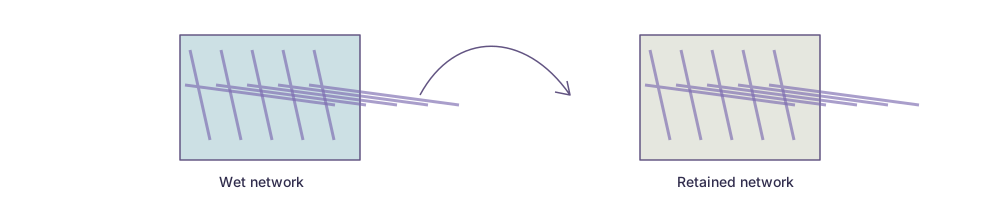
Why ordinary evaporation can change a structure
As liquid evaporates from small pores, a boundary between liquid and gas moves through the material. Surface tension at this boundary can create capillary stresses. A fragile solid network may shrink, crack, or collapse as a result.
Supercritical drying takes a different route. Above a substance’s critical temperature and pressure, the distinction between its liquid and gas phases disappears. A controlled drying path can avoid the liquid–gas interface that would otherwise stress the pore network. This principle is used in preparing some aerogels.
The route is part of the result
The working fluid, the starting material, and the way conditions change all belong in the description. This is a conceptual explanation of the mechanism; an actual process requires purpose-built equipment and a material-specific procedure.
Two hypothetical samples could begin with similar wet structures yet finish with different shapes after different drying routes. To explain that contrast, a caption needs more than before-and-after photographs: it needs to identify how the liquid was removed and which interface-related stresses were avoided.
General educational reading. This article does not describe ALL COURT PRODUCTIONS products, services, or activities.